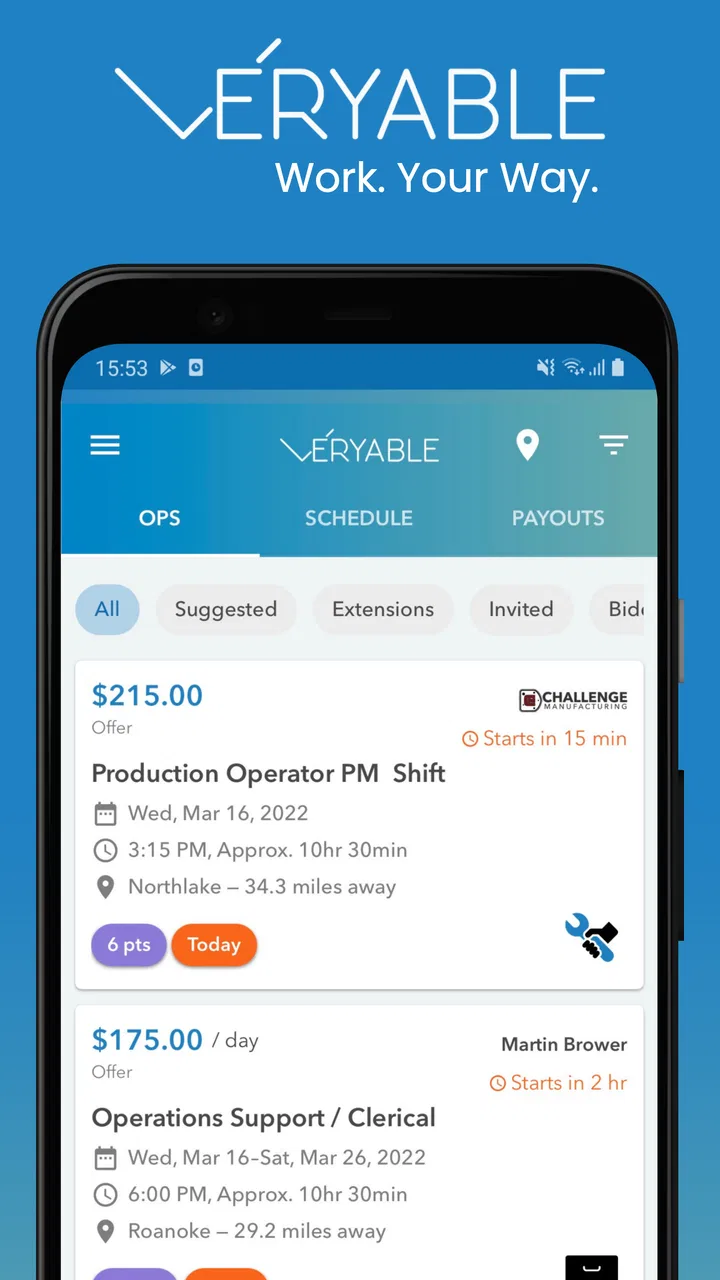
Veryable: Work. Next Day Pay
- 4.3
- Rating
- 1.00M
- Installs
- Free
- Price

 Analysis by App-foxy
I approached Veryable: Work. Next Day Pay as a practical business app rather than a typical job-search tool. Its purpose is to connect people with flexible work opportunities, while putting emphasis on scheduling, skill development, perks, and faster access to earnings. That combination makes it interesting for anyone who wants more control over when they work, but it also means the app deserves a closer look than a quick download followed by an immediate sign-up.
In my experience, the most important question is not simply whether the app is free. It is whether the available work fits your schedule, whether you understand the requirements before accepting it, and whether you are comfortable sharing the information needed to manage an account and work arrangements. Veryable, Inc. has built a recognizable business service around that flexible-work model, and the app has reached over a million installs with an average rating of 4.2 from roughly twelve thousand ratings. Those figures suggest meaningful adoption, but they do not remove the need for personal judgment.
How the flexible-work model feels in everyday use
The app is designed for people who do not want their working life organized around one fixed weekly pattern. That can include someone between jobs, a person looking for additional shifts, or a worker whose availability changes from week to week. Instead of treating flexibility as a vague promise, the experience is centered on choosing opportunities that appear compatible with your time and abilities.
You May Also Like

 Blood Strike: 2.5 Anniversary
Blood Strike’s Loadouts Turn Every Drop Into a Tactical Gamble
A close look at Blood Strike’s custom loadouts: how fast access to signature weapons reshapes its battle royale rhythm, rewards preparation, and narrows the gap between fights.

 Pandora - Music & Podcasts
Pandora’s Music Is Easy to Start, but Harder to Recover
Pandora’s strength is its low-effort path from a seed to a station. Its weak spot is how much confidence it asks you to place in connection, setup, and quiet recovery.

 8 Ball Pool
 Is Built on Rivalries, Rematches, and Routine
A close look at the rivalries, rematches, shared routines, and unanswered safety questions that turn a quick pool match into a persistent mobile community.

 Samsung Music
’s Quiet Strength Is Playing What You Already Own
Its reach comes less from spectacle than from dependable access to a personal library. That simplicity is both the app’s strongest retention engine and its ceiling.

 AccuWeather: Weather Radar
AccuWeather Review: A Quick, Clear Forecast for Everyday Decisions
For everyday plans, the best forecast is the one you can understand quickly. AccuWeather makes rain timing, radar, and local conditions easy to act on, with a few trade-offs.

 Hill Climb Racing
Why Hill Climb Racing Still Turns Crashes Into One More Run
A tiny car, a bumpy hill and one more upgrade: Hill Climb Racing keeps resurfacing because its simple chaos makes every near-miss feel personal.
More From Our News Desk



A realistic example would be a person who has an open weekday after a regular commitment. Rather than contacting several employers and waiting for replies, that person can use the app to review available work, consider the timing and expectations, and decide whether a particular opportunity is worth pursuing. The useful part is not just finding something quickly; it is being able to compare the commitment with the rest of the day before saying yes.
That convenience has a trade-off. Flexible work is only genuinely flexible when the available opportunities match your location, skills, transportation, and schedule. An app can make the search and selection process easier, but it cannot guarantee that the right work will appear when you need it. I would therefore treat Veryable as a way to improve access to opportunities, not as a replacement for a guaranteed income or a conventional employment arrangement.
The store positioning also highlights daily pay and skill building. Those ideas matter because they address two different needs: immediate cash flow and longer-term employability. Someone who needs money sooner may care most about how quickly payment becomes available, while another user may be more interested in gaining experience that opens additional opportunities later. I would keep both goals in mind instead of assuming the app will serve them equally well.
Who is likely to benefit most
I see the strongest fit for people who can make decisions quickly, keep their availability current, and judge work opportunities realistically. If your schedule changes often, a flexible marketplace can be more useful than a standard job board that focuses mainly on permanent openings. It may also suit someone who prefers reviewing several possibilities rather than committing to one employer immediately.
The app can be especially practical when you already know what kind of work you can perform and what hours you can accept. That knowledge helps you filter mentally before spending time on an opportunity. It also makes the skill-building angle more useful, because you can identify assignments that build on what you already know instead of treating every listing as interchangeable.
I would be more cautious if you need predictable hours, a fixed salary, or a long-term benefits package. A flexible-work application is not the best substitute for a conventional employer when stability is your main priority. It may also be a poor fit if transportation is limited, if your availability is extremely narrow, or if you cannot tolerate last-minute changes in your working plans.
What the free download does and does not mean
The app is free and rated for Everyone, which lowers the barrier to trying it. It is available for devices running Android 7.0 or later, and the current version is 6.7.7. I would still check the device requirements before installing, particularly if you use an older phone, because work-related apps are only helpful when they run reliably during the moments you need them.
Free access should not be confused with risk-free use. The real commitment begins when you create an account, review work details, and decide whether to participate. Before accepting anything, I would read the full opportunity information, note the expected timing, and make sure the arrangement fits my own circumstances. That habit is more valuable than relying on the app’s general promise of flexibility.
Trust, controls, and the moments that deserve attention
When I think about trust in a work app, I focus on the decisions a person makes along the way: what information they share, which opportunities they accept, and how carefully they review the terms attached to each choice. I’d treat those moments as part of using Veryable, not as setup chores to rush through, because a little attention can prevent avoidable confusion later.
Account choices should be treated as part of the review
For a work platform, trust is built through visible choices rather than slogans. When I evaluate an app like this, I look for clear account steps, understandable requests for information, and a straightforward way to review what I have entered. I also want to know what I am agreeing to at each important stage, especially when moving from browsing opportunities to applying or accepting work.
Veryable’s value depends on an account that represents the worker accurately. That means details such as availability, skills, and contact information are not minor profile decorations. They influence whether an opportunity is relevant and whether communication can happen properly. My practical advice is to keep the profile precise and current, but avoid adding personal information that is not necessary for the service to function.
I would also pause at any screen that requests a new piece of information. A request can be reasonable in a work context, yet the right response is still to understand why it is needed and how it affects your use of the account. If the explanation is easy to follow, that supports confidence. If you feel rushed or cannot tell what a choice means, postpone the step and review the available account or privacy controls first.
Data-sensitive moments are not all the same
The most sensitive moments are usually not the initial download. They are the points where a user creates an identity, supplies work-related details, communicates with others, or handles payment-related information. I would give each of those stages separate attention instead of treating the entire app as one simple permission decision.
For example, a person may be comfortable sharing basic contact details to receive work information but less comfortable sharing additional personal details before understanding the opportunity. That is a reasonable distinction. The safest workflow is to provide accurate information where it is required, read the purpose shown on screen, and avoid guessing when a field or permission is unclear.
I would use the same care with notifications. Work opportunities can be time-sensitive, so alerts may be useful, but notification access can also expose information on a lock screen or interrupt you at inconvenient times. If the device allows notification previews to be limited, I would consider doing that. This preserves awareness without automatically displaying every detail in public.
Location-related choices deserve similar thought. A flexible-work service may be more useful when opportunities can be matched to where you are willing to work, but I would prefer the narrowest setting that still supports the feature I need. If an option allows location access only while using the app, that may be a sensible starting point. I would not enable broader access simply because the request appears during setup.
Daily pay needs careful expectations
The promise of daily pay is appealing, particularly for someone managing irregular expenses. Still, I would not interpret it as money appearing immediately after every action. Payment depends on the work arrangement, completion, and the steps required to process earnings. Before relying on it for rent, transport, or a bill, I would make sure I understand when payment becomes available and whether any action is required from me.
This is one of the clearest examples of where user agency matters. The app can present a faster-pay option, but I remain responsible for checking the conditions attached to a specific opportunity. I would also keep personal records of completed work and expected payment until the process becomes familiar. That small habit makes it easier to spot a misunderstanding early.
Someone who needs guaranteed same-day access to money should be especially careful. The phrase “daily pay” can sound immediate, while real-world processing may still involve timing and verification. I would use the feature as a possible cash-flow advantage, not as a reason to accept work that otherwise does not fit.
Useful habits for controlling the experience
My first recommendation is to separate browsing from accepting. Review several opportunities before committing to one, even if the first option looks attractive. Compare the schedule, required skills, travel burden, and likely effect on the rest of your day. This prevents the common mistake of treating availability as the same thing as suitability.
My second recommendation is to keep a simple personal checklist. Before accepting work, I would confirm the start time, location, expected task, required preparation, and payment-related details shown in the app. This is more reliable than depending on memory, especially when considering several opportunities in a short period.
Third, I would review the account after any major change in circumstances. If your phone number, availability, skills, or preferred working area changes, update the relevant information promptly. An outdated profile can lead to poor matches and unnecessary communication. Keeping the account accurate is one of the few controls entirely within the user’s hands.
Finally, I would periodically inspect the app’s permissions through the phone’s system settings, not only during installation. This gives you a clearer view of what the app can access and lets you adjust choices later. It is a useful practice for any business app, but particularly for one connected to work, identity, scheduling, and payment decisions.
How it compares with familiar alternatives
Compared with a traditional job board, Veryable feels more focused on flexible participation than on browsing permanent vacancies. A job board is usually better when you want a conventional role, a formal application process, and a longer-term relationship with one employer. Veryable is more appealing when your priority is seeing work possibilities that can fit around changing availability.
Compared with asking friends, contacting local businesses, or using informal social groups, the app offers a more organized place to manage opportunities. Informal methods can sometimes produce better personal context, but they also require more messages, more follow-up, and more effort to compare options. The app’s advantage is structure; the disadvantage is that a structured marketplace may feel less personal.
Compared with a standard scheduling tool, it is not merely a calendar. A calendar helps you manage commitments you already have, while this app is intended to help you find and evaluate work. I would use a calendar alongside it rather than expecting one to replace the other. Recording accepted commitments separately can reduce the chance of double-booking yourself.
The best alternative depends on your goal. If you need stability, pursue conventional employment channels as well. If you need occasional work and can make careful decisions about availability, this app may be more relevant. I would not rely on one source alone when income is important; combining flexible opportunities with a longer-term plan is more sensible.
Where the experience may create friction
The flexible model can require more personal organization than a fixed job. You may need to monitor opportunities, keep your profile accurate, evaluate travel, and manage changing commitments. For some users, that freedom will feel empowering. For others, it may feel like extra administrative work that an employer would normally handle.
There is also a psychological trade-off. Seeing multiple opportunities can create the impression that work is always available, even when the available choices are not suitable. I would judge the app by the quality and practicality of the opportunities you can actually use, not by how many possibilities appear on a given day.
Another limitation is that flexibility does not automatically equal control. Your preferred schedule may not align with the work available, and skill-building only helps when the opportunities genuinely match your interests and abilities. I would avoid accepting something merely because it is visible. A poor fit can cost time, travel expenses, and energy.
These are not reasons to dismiss the app. They are reasons to use it deliberately. The service is strongest when the user treats each opportunity as a decision requiring basic planning, rather than as an automatic solution to employment or cash-flow problems.
My cautious verdict
Veryable: Work. Next Day Pay is a credible option to consider if you want flexible work opportunities, value control over your schedule, and are willing to manage the details yourself. Its free access, business focus, daily-pay emphasis, and skill-building direction give it a clear identity. The app has been available since March 5, 2017, and its current version shows that it remains an actively maintained part of that service.
I would recommend trying it to a friend who needs occasional work, can evaluate opportunities carefully, and understands that flexibility comes with responsibility. I would not recommend using it as the only plan for someone who needs guaranteed hours or predictable income. In that situation, a conventional job search should remain the priority.
My final advice is to start slowly: create an accurate account, review the visible choices, inspect permissions, compare opportunities, and accept only work that fits your real schedule. The strongest reason to use this app is not the promise of instant convenience, but the possibility of making better-informed work choices on your own terms. If that kind of independence suits you, Veryable is worth exploring. If you prefer an employer to provide stability and handle the scheduling structure, another route will probably serve you better.
FAQs for Veryable: Work. Next Day Pay
01What is Veryable and how does it work?
Veryable is an app designed to connect workers with on-demand manufacturing and warehousing jobs. Users can browse available opportunities, apply for short-term gigs, and get paid the next day. The app provides flexibility for workers seeking temporary assignments without the commitment of full-time employment.
02Is Veryable available in all regions?
Veryable primarily operates in select U.S. cities and regions where there is a high demand for flexible labor in manufacturing and warehousing. Users should check the app or website to verify availability in their area. Expansion to new regions is ongoing, so keep an eye out for updates.
03How does payment work on Veryable?
Workers on Veryable receive next-day payments for their completed gigs, as long as they adhere to the job's requirements and deadlines. Payments are typically processed through the app and delivered via direct deposit, ensuring quick access to earned wages without the usual wait times.
04Are there any fees for using Veryable?
While downloading and using the Veryable app is free for workers, there may be nominal fees associated with specific payment processing methods. Workers should review the app’s terms and conditions to understand any potential costs. Employers, on the other hand, might incur fees for listing job opportunities.
05What type of jobs can I find on Veryable?
Veryable specializes in short-term gigs within the manufacturing and warehousing sectors. Users can find diverse roles such as assembly line work, inventory management, packaging, and more. Each job listing provides details about the tasks, requirements, and duration, allowing workers to choose assignments that fit their skills and availability.
Pros
- Flexible work schedule options.
- Quick and easy payments.
- User-friendly interface.
- Wide range of job opportunities.
- No long-term commitments.
Cons
- Limited to certain regions.
- Inconsistent job availability.
- Requires frequent app updates.
- Some jobs may pay low rates.
- No benefits or job security.

Veryable: Work. Next Day Pay
Gallery